Saturday, June 13, 2015

Sake No. 008 "Suigyoku, Muroka-Nama, Tokubetsu-jyunmai"

Hello everybody!

Tokyo enters soon in a season of the rainy season.
I come to feel slightly depressed because it is that it seems to be prolonged particularly this year. I cannot go to the favorite mountain either.
In such a case, I drink the Sake and want to switch a feeling.

By the way, The Sake which I introduce this time is "Suigyoku, Muroka-Nama, Tokubetsu-jyunmai". "Suigyoku" means the emerald.  It is the bright green that followed it on a label. The meaning of Suigyoku is emerald. It is the bright green that followed it on a label. Surely it would be named towards elegant, clear Sake such as the emerald.

This is"Suigyoku, Muroka-Nama, Tokubetsu-jyunmai". The letter of the label is green to remind of emerald.

Outline

It is Ryozeki-Brewery in Yuzawa-City (湯沢) of South Akita to produce Suigyoku. Therefore this Sake made in the Tohoku district.

Speaking of Akita, it is the prefecture which many popular Sake is made in. I skip those introductions on the next time when I enumerate the brands that there is the number because it is boundless. In addition, in a small range called this Yuzawa-city, Brewery of six places of big things and small things gathers in the first on the list in a big brewing maker called Akita-Mejo-Brewery (秋田銘醸) makes Ranman (爛漫), and there is at all a prosperous town of the Sake brewing.


By the way, about Ryozeki-Brewery in such a fierce battle ward, the brand making as the center is a thing named Ryozeki according to the name from the brewery. However, a lot of things that heat-treatment and alcohol-addition were performed in this Ryozeki are not trendy Sake now. However, they have much amount of production in attracting that it was established the uniformity around a hometown, and the factory to make them is so big.

It is a heavy snowfall area because Yuzawa is a city of the inlands in the Sea of Japan side. Considerable snow is piled up in the city area.
However, the Sake such as such Futsu-shu or Honjozo didn't gradually sell, and it was in a situation that the Ryozeki-Brewery couldn't but switch a policy.

That's why, as a thing differentiated from the conventional Sake, new brands such as Suigyoku (翠玉) and Hanamura (花邑) were born. Ryozeki-Brewary has the history and the ability that made much Sake so far. In addition the factor that they were taught how to make by Takagi-brewery (高木酒造) of famous Yamagata directly in Juyondai (十四代) made them popularity in no time, and they became the one of Sake where it was difficult to obtain it in Tokyo.

I hope for those increases in production in Ryozeki-brewery.
This is Ryozeki-Brewery lined with wooden big warehouses. The comings and goings of the person have vigor intensely at the time when the Shinshu (New Sake) is just shipped.

Character

Name: "Suigyoku, Muroka-Nama, Tokubetsu-jyunmai" (翠玉、無濾過生、特別純米)
Place: Ryozeki-Brewery (両関酒造), Yuzawa, Akita prefecture
Class: Tokubetsu-junmai
Rice: Unknown (Made in Akita)
Rice polishing rate: 59%
Yeast: Unknown
Filtration: No
Heat treatment: No
Water addition: Yes
Alcohol content: 16%
Sake meter: Unknown
Acid meter: Unknwon
Price: JPY 1,577 (720 ml)
Official website: http://www.ryozeki.co.jp/
My rating: AA

This is a manual. After all it is written that this is a Sake which was made while imaging emerald.

Taste

I brought a nose close to this Sake, and it was a clear refreshing sweet fragrance of the streets of the brand names first that felt. It was sweetness to feel the refreshing feel that let me imagine a melon.

By the way, how is the taste? The first impression that I when I took a sip had was the sweetness that was apt to decline a little. However, it gradually spread through the whole tongue and began to gradually insist on presence, and an impression changed completely first.

The layer of the sweetness was deep and was the taste that it was very complicated, and was interesting. I was made to imagine emerald by the mysterious, green, clear sweetness.

There were a fewer acidity and dry tastes than sweetness, but let the sweetness that they spread through converge neatly. Therefore, sweetness was the Sake of the main constituent, but was taste to drink, and not to get tired of.

It doesn't disturb the dish because Suigyoku is light sweet liquor. Therefore it is congenial to any dish.

My story

It is the end of the year of 2011 that I visited Ryozeki-Brewery. I went to the Tohoku district for a volunteer and a reconstruction aid while the horrible trace of that East Japan great earthquake disaster was left.

The outward journey was a tsunami stricken area of the Pacific side. The return journey was an inland. I bought the Sake for a return at that time as a souvenir.

This is Shizuwaga of Minamisanriku-town in Miyagi where damage in particular was heavy. Houses formed a line before a tsunami attacks it, but it is drained all now, and it becomes vacant lots.
I've already drunk many Sake those days. However, I didn't know Ryozeki-brewery because I wasn't familiar a lot with the field as now. Of course the popular Sake did not yet exist as of one such as Suigyoku or Hanamura in those days. Therefore what I visited in this Brewery was really accidental.

This is old wooden Yuzawa Station. But it was rebuilt newly now, and the taste disappeared. I was disappointed.
It snowed, and the towns of Yuzawa were piled up when I went there. I walked the town while my watching the scene, and feeling winter. I visited some Brewery which there was in the city while it snowed in my having known that it was the city that Yuzawa was made with the Sake, and was famous a little.

I liked a building of Ryozeki-Brewery where was excellent built in that and bought the slightly high-quality Sake called Setsugekka (雪月花) there. When the taste was good, I memorize it.

This is remains of Yuzawa-Castle which there was in the times in the Middle Ages. The town of Yuzawa was formed as a castle town and prospered as Shukuba-machi of the Dewa-street after the Edo era.
Three years later, when I saw "Hanamura, Junmai-ginjo" in a favorite bar, I didn't notice that it was a thing made in Ryozeki-Brewery first. I heard the waiter "Where it was a made?" because it was very delicious, and was surprised a little. I reevaluate Ryozeki-Brewery by the matter, and I drink Hanamura and Suigyoku willingly now.

This is "Hanamura, Junmai-ginjo, Nama". It is a simple design, but some fonts are odd.

How to buy (or drink)

For Ryozeki-Brewery, this Sake is still a thing of the experiment stage, and amount of production is very few. So unfortunately I don't know the shop sold in Tokyo. I don't see even a bar very much. It is sold out immediately even if I see it.

You should search with the word "翠玉 日本酒" if you want to drink "Suigyoku". "花邑 日本酒" if "Hanamura". However, I cannot guarantee the stock.
http://tabelog.com/

It seems to be angry at you and I am said "Why did you introduce such Sake is hard to obtain?" when I say such an irresponsible thing, but the taste is surely delicious. Please drink if, fortunately, you can meat this Sake.

Tuesday, June 9, 2015

Sake No. 007 "Iwao, Nyukon-Jikagumi, Tokubetsu-Junmai, No.701, authentic"

Hello everybody. Do yo drink the dericious liquor?

Summer approached, and Japan has begun to get so muggy recently.
It is an unpleasant season, but is the season when cool beer becomes delicious.
Of course the cool Sake will be delicious too.


By the way, I introduce "Iwao, Nyukon-Jikagumi, Tokubetsu-Junmai, No. 701, authentic" this time. This is a label of a thin pink gorgeous design. It will be outstanding conspicuously in various Sake.

This is "Iwao, Nyukon-Jikagumi, Tokubetsu-Junmai, No.701, authentic". A label stands out with pinkness is impressive.
"authentic" of the last name is just written by an English word.
In addition to it, a seal written as "Authentic and Sexy" in the upper part of the bottle is completed.

When Jikagumi is the Sake with a feeling of a few carbonate that performed bottling from a direct tank, I commented, but Nyukon associated with it is not a term of the Sake anymore.

The meaning "puts my soul". I suppose that it is the meaning that the brewery laid emphasis on in particular.

Outline

Takai-Brewery where Iwao is prepared into is in southern Fujioka-shi of Gunma of North Kanto region.


Speaking of North Kanto, Tochigi and Ibaraki are to the east of Gunma, but the Sake of Tochigi is popular in that recently. Actually, there is the Sake which I like more than ten there.
However, the delicious Sake isn't a little in Gunma. Of course there are them in Ibaraki too.

There is Takai-Brewery in the place called Fujioka (藤岡) of Gunma. There was formed as a castle town in the Middle Ages and prospered in sericulture business after the Edo era. There is the Tomioka filature which is famous because sericulture business became the world heritage in Tomioka-shi of the neighborhood. There aren't the audacious remains of an ancient structure in this Fujioka-shi, but it is ever indicated that this neighborhood was a large-scale silk production place.

This is the inside of the Tomioka filature. There established in the Meiji era were innovative facilities about the silk. It is the facilities which are famous so that it is placed in the textbook of the history in Japan.
There became the satellite city of Takasaki-shi that was substantial metropolis of Gunma now, and most of the former characteristics were lost. It is City which is not so big, but the popularity is high in people living in relatively near Tokyo because there is the junction of the highway. By the way, this neighborhood is the place that is relatively familiar for me because it is the place that passes on a train of Hachiko-Line (八高線) when I travel to the Niigata or Nagano area.

This is a train of Hachiko-Line via the Fujioka city. The transport volume is a small local line, but, in the case of a trip, I sometimes get on when I go to Gunma from the west of Tokyo because it is a convenient route. I photographed this photo at Kodama (児玉) Station.

Character

Name: "Iwao, Nyukon-Jikagumi, Tokubetsu-Junmai, No.701, authentic" (巌、入魂直汲み、特別純米、701号、authentic)
Place: Takai-Brewery (高井), Fujioka, Gunma prefecture
Class: Tokubetsu-Junmai
Rice: Miyamanishiki 81% and Gohyakumangoku 19%
Rice polishing rate: 55%
Yeast:  The Society No.701 (協会18号)
Filtration: Yes
Heat treatment: No
Water addition: No
Other characteristics: Jikagumi
Alcohol content: 17-18%
Sake meter: +1
Acid meter: 1.9
Price: JPY 2,916 (1,800 ml)
Official website: http://www.gunma-sake.or.jp/iwao/
My rating: AA

A lot of manuals are written. The part for the first half is comment of the brewery.

Taste

About the fragrance, a sweet fragrance to associate a pear swells out in my nose. It is the comfortable, soft fragrance that I want to smell forever.

When I drank one share, some carbonic acid insisted on existence because it was Jikagumi. When it was calm down, The bittersweet acidity such as the fruit and the sweetness that I am made to imagine by the fragrance spread. It was written as sexy on a seal, but was right the impression of the street.

The sweetness gradually faded away, but the acidity continued insisting till the last, and it was swallowed last in a little dry taste. It was the splendid Sake where various taste created stories. There is no sense of incongruity in substitution for the white wine because acidity is strong.
The affinity was the best when I ate with bouillabaisse.

Acidity of a Sake enhances the taste of fishery products. These are exquisite combinations.

How to buy (or drink)

There are few numbers so far like Sake which I introduced, and Iwao is Sake which it is hard to obtain. However, in late years the bars to stock continue increasing, and I think that it may become the brand of popularity sometime soon. You can buy it in Uemo-Shop (google maps) of Nerima in Tokyo.

There are relatively many places where the bar is stock, but has a hard time when you search it because it is kanji one character. Please search it with "いわお 日本酒". However still it is not complete.
http://tabelog.com/

Friday, June 5, 2015

Sake No. 006 "Konna-Yoruni, Sanshouo, Jungin-Nakadori, Nama-Genshu, Shinko-545"

Hey! How is everyone?
Do yo drink dericious liquor usually?
Today, I introduce this Sake.

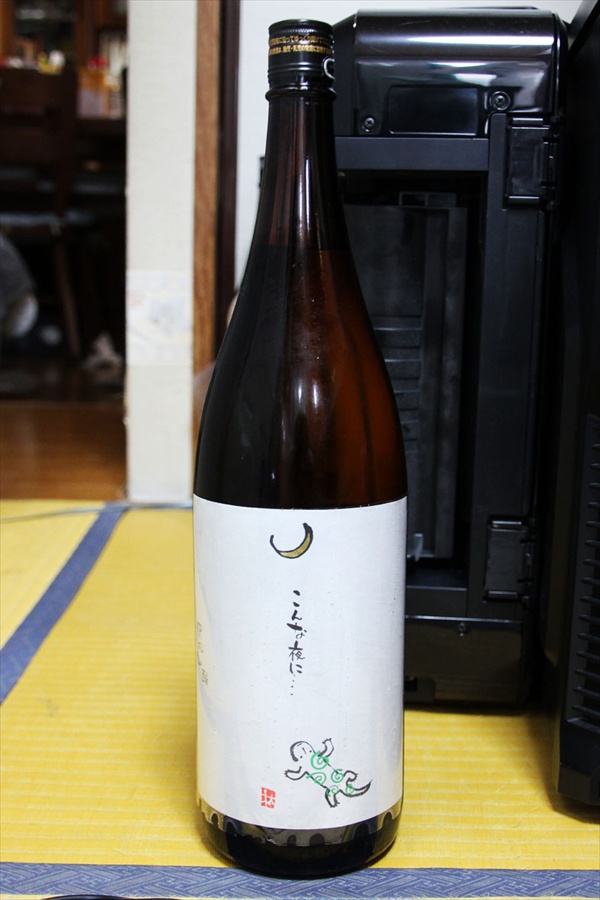
This is "Konna-Yoruni, Sanshouo, Jungin-Nakadori, Nama-Genshu, Shinko-545". What do you think about this label? starange? cute?
In any case will this look like the label which is not much Sake-like? A Sake of such an individual label is increasing recently so far though I did not introduce you very much.

This Sake is "Konna-Yoruni, Sanshouo, Jungin-Nakadori, Nama-Genshu, Shinko-545". There is a deformed salamander below.
Though the label is so, some name in itself of this Sake are odd. "Konna-Yoruni" of the brand means "At such a night". You drink such a Sake at such a night. Probably.

By the way, the official brand name is called Kuromatsu-Senjo, and this brand name is added to this Sake by the official name. Kuromatsu is the crowd of in the place where family name, Senjo are imminent for the brewery founders making this Sake.

In addition, "Sanshouo" is shown at Salamander in Japanese. Probably, as for the series of this brand, the name of a creature inhabiting near the brewery is acquired each. The kind includes full moon (満月), salamander (山椒魚), trout (山女), deer (鹿), snow grouse (雷鳥). The full moon is not a creature. By the way, this salamander points at Junmai-Ginjo.

"Jungin" means an abbreviation of Junmai-Ginjo to understand it from the thing. "Nakadori" means the thing of a squeezed middle stage. Therefore, the thing which is squeezed at first, and comes out is called "Arabashiri", and it is called "Seme" last to come out. I intend to supplement it by a lecture soon because this neighborhood has not yet explained it.

I skip because you do not need to write Nama-Genshu. Last Shinko-545 shows a used kind of rice. This series doesn't  usually have the supplement, but note reason is touched because this Sake is a special Sake where rice cultivated experimentally was used for.

Oops it has become so long only by the supplement of the name of Sake.

This scenery is a view near Mt.Senjo. The mountaintop is the right high place. It is a low mountain of the degrees of difficulty to be able to climb it to the mountaintop from Kitazawa-Pass which is a starting point of a mountain climb in approximately four hours in the summer.

Outline

Senjo-brewery making this Sake is in Nagano in the inland of the Japanese Islands. There is Brewery in the south side of Nagano, the place called Takato (高遠) in Ina-City (伊那) in the Ina district.


Takato is the historical castle town where a castle made for the age of civil strife was formed as a nucleus. Tourists rush when this castle is spring for celebrity nationwide as a famous place of the cherry blossom viewing. However I cannot place a photograph because I've not been to this town, but think that the photograph which you expect makes a hit a lot if you search it with the search-word "Takato cherry blossom festival".

Although I've not been to the town, but went to Mt.Senjo which the name of Brewery and the brand was derived from in last autumn. Though it is a high mountain in Japan more than 3,000m, I recommend it because it is easy to climb it for this nearby mountain. Of course climb it after fixing the equipment properly.

Therefore the water that slush of this Mt.Senjo became the underflow water is used for the Sake made in Senjo-brewery. The water filtered in the underground for a long time becomes the very delicious water. As for the making of the Sake made with only rice and water, the quality of water is one of the biggest factors. The Sake made there is good if water is delicious. Therefore some my favorite Sake are in Nagano of the mountains topography.

Character

Name: "Konna-Yoruni, Sanshouo (Salamander), Jungin-Nakadori, Nama-Genshu, Shinko-545" (こんな夜に、山椒魚、純吟中取り、生原酒、信交545)
Place: Senjo-brewery (仙醸), Ina, Nagano prefecture
Class: Junmai-ginjo
Rice: Shinko-545 (信交545)
Rice polishing rate: 50%
Yeast: Unknown
Filtration: Yes
Heat treatment: No
Water addition: No
Other characteristics: Nakadori
Alcohol content: 17%
Sake meter: Unknown
Acid meter: Unknown
Price: JPY 3,456 (1,800ml)
Official website: http://www.senjyo.co.jp/
My rating: AA

There is a poem to the back right. It means "The salamander looks up at the moon at such a night, too".

Taste

The fragrance was very modest. I felt sharp translucent sweetness subtly.

When I took a sip, at first firstly I felt gorgeous acidity. The quality of the acidity was sharp, but it wasn't stinging and was comfortable. After, sweetness and a little dry taste were delayed and came over. They spread through the tongue slowly, and the acidity that stayed in from a beginning tightened all afterwards.

Probably it will be this experimental characteristic of rice. Unique acidity was the most impressive and was the taste that increased sweetness peculiar to the Sake to white wine.
Therefore I felt like matching Europe dish including the spaghetti well.

The affinity with tomato dishes is unexpectedly good. So I usually drink this Sake when I eat Europe dish.

How to buy (or drink)

Unfortunately this Sake is uncommon at the retail store. The shop which is stocked when "Konna-Yoruni-Series" is Tokyo has in particular only a few. Tokyo is stocked in Jizakeya-Kodama (google maps) in Otsuka.

There are many places where "Kuromatsu-Senjo" is put in the bar, but there are considerably few places where "Konna-Yoruni-series" is put. You should search with the word "黒松仙醸" if you want to drink "Kuromatsu-Senjo". "こんな夜に" if "Konna-yoruni".
http://tabelog.com/

Tuesday, June 2, 2015

Sake No. 005 "Yanma, No.3, Tokubetsu-junmai, Muroka-Nama-Genshu"

Hello everyone! I'll usall introduce the Sake.
It is instant that another fifth, time pass if they notice.
I think that the introduction of Shochu is parallel and wants to perform it, but I do not have the knowledge about Shochu that much soon.


About this time, I introduce this one. "Yanma, No.3, Tokubetsu-junmai, Muroka-Nama-Genshu".
It is a Sake which I introduce this time, but finally takes up a thing made in Niigata for the first time. So let's touch it about the history of the Sake of Niigata that is called the sacred place of the Sake lightly.

The person who knew a lot about some Sake has heard a story that there was the so mach delicious Sake in Niigata. Actually, Niigata is the prefecture that the number of Sake-brewery is number one in Japan. And the amount of production is next to Hyogo (Including Nada, 灘) and Kyoto (Including Fushimi, 伏見) with many large-scale companies by the making of the Sake now for a long time, too. There will be many people who have drunk the Sake which was made there before people notice because famous Hakkaisan (八海山), Kubota (久保田), Koshino-kanbai (越乃寒梅) are made in this prefecture.

"Yanma, No.3, Tokubetsu-junmai, Muroka-Nama-Genshu". The label is simple.

Certainly, Niigata is the birthplace of Echigo-Toji(越後杜氏, Echigo is Niigata. "Toji" means "The teacher of making Sake".) which spread the making of the Sake in the whole country. However, it is not about old days that much in the 1970s that the Sake of Niigata won popularity.

In Japan before it, poeple strongly had an image called "The Sake must be the sweat liquor". However, the sweetness is not organic quality derived from rice such as the current delicious Sake. When the Sake was deluted as for them in the postwar poor times, they are the things which sugar and a sweetener were added to artificially so that taste doesn't fade away. Naturally those taste was so terrible. Such the cheap Sake is still sold in a supermarket or a convenience store.

It is that Koshino-kanbai which is famous for a certain magazine was introduced to have been a turning point. The people who shrank from conventional the sweet Sake were impressed by an appearance of the Sake of novel taste of "Crear and Dry". The Sake of Niigata is not available in the big city, and the anecdote that reached the Sake desire for acquisition of Niigata expressly to the field is left in those days.

However, there was the much Sake of the taste that was thick rather than the taste that Niigata looked like it from those days having been the central force. Therefore, many many other Sake brewery switched a policy to "Crear and Dry" in sequence. This fashion spread to the beer industry, and "Super-Dry" of Asahi was born later.

The explosive popularity relatively continues from there up to these days, and the Sake made in Niigata shall be firm at the position.

However, conversely "Crear and Dry" abandons the original taste and personality completely because those Sake are filtered more than required. Some Sake was delicious, but it became only similar thin the Sake everywhere generally, and the consumers have begun to get tired.

So reaction was taking place again in the here these days, and the Sake of sweet taste came to gradually win popularity. This trend was caused by Juyondai (十四代) in Yamagata. Therefore the breweries in Niigata where they make the Sake of "Crear and Dry" into was troubled so far.

The Sake of the major maker where the name is famous like Hakkaisan is all right because it is not yet a big change, but taste is all for the small breweries, and it is a vital question that is said that taste is outdated. So the places that gradually change direction increase.

In other words, the breweries in Niigata is made to stand in the forked road. However, it will be easy to get on the present trend if they start seriousness because the potential that they have is high. I expect it.

Ponshu-kan (means "The house of the Sake") is the amusement facilities of the Sake in Echigo-Yuzawa station. You can drink five cups of the Sake for 500 yen once in these facilities. There are very many kinds, and all thing 93 kinds of all Sake-brewery of Niigata are always stocked. In addition, the same facilities are at Niigata Station of the prefectural seat. As for you, you should drink some Sake with moderation in the state such as the doll in the left not to become.

Outline

Niigata-Daiichi-Brewery making Yanma is in Joetsu-shi (上越) in West Niigata. Yanma of the brand name is the meaning called the valley. There is it in the place that the brewry is far from the plains, and entered the valley a little to understand it from it.


It is approximately 20km from central Takada in Joetsu. There is the brewery in the quiet farm village where a rice field is outstanding in summer. By the winter beginning, the fields were buried among snow when I went. Joetsu is a heavy snowfall area outstanding in Japan. I seem to be piled up to 2m (6.6ft) above the ground when it is much time.

Speaking of Joetsu, Kenshin-Uesugi (上杉謙信) who is Daimyo (means feudal lords) ruling this area for the age of civil wars is famous for many Japanese, and a lot of historic spots such as the sites of castle about it stay in the city. There is much interesting highlight in the outskirts. For example, "Kasugayama-castle where Kenshin Uesugi resided", "Takada-castle where Matsudaira-family (松平氏) who delivered this ground resided in the Edo era", "Tera-machi (Temple town) where 65 temples gather" etc.

It wasn't difficult to travel recently because the Shinkansen was inaugurated and became convenient. We can come to this ground from Tokyo Station in approximately around two hours.

This is Kasugayama-castle covered in snow. Main Uesugi-Kenshin of this castle is a hero for a citizen there.

Character

Name: Yanma, No.3, Tokubetsu-junmai, Muroka-Nama-Genshu (山間3号、特別純米、無濾過生原酒)
Place: Niigata-Daiichi-Brewery (新潟第一酒造), Joetsu, Niigata prefecture
Class: Tokubetsu-Junmai
Rice: Gohyakumangoku (五百万石) and Koshi-ibuki (こしいぶき)
Rice polishing rate: 60%
Yeast: Unknown
Filtration: No
Heat treatment: No
Water addition: No
Other characteristics: Jikagumi (Direct bottling)
Alcohol content: 17%
Sake meter: Unknown
Acid meter: Unknown
Price: JPY 3,150 (1,800ml)
Official website: http://www.sake-hakuchou.com/
My rating: BBB

Caption. This number is a meaning of the turns of a made tank. In other words, in this Sake, it was done a bottle by the third tank

Taste

I wrote that "the liquor of Niigata is "Crear and Dry" generally", but, in this Sake, the taste that seems to get rid of the trend is one of a thick taste brand first.

About the fragrance, there is little sweetness such as the fruit. They pierce my sense of smell with sharpness.

The next is the Taste. I felt a strong bubbling to remind me of Kassei such as the last Nabeshima, because the carbonic acid of the fermentation stage didn't come out of the first share impression above all in Jukagumi. The bubbling strength was too strong and taste loses when I just opened out, but taste gradually grew up when I put it for around one month.

And, about the taste, a lump of slightly square-built Umami jumps with dry taste and good acidity. The acidity in particular stimulates a tongue moderately keenly.

However, mellow, comfortable sweetness spreads through the whole of the mouth just after that and implants a calm impression in my tongue.

Therefore finally, slight bitterness peculiar to Gohyakumangoku which is used rice tightens the expanse of the taste. It was the thick Sake, but was taste without getting tired really.

I think that the affinity with fishery dishes is good, because not only I say a just sweet Sake, but also acidity tightens the whole, and an intonation is touched well.

Because this is a Sake which is not too sweet, the affinity of fish dishes is good. I recommend Sashimi and sushi in particular.

My story

It is about the beginning of the year of the last year that I drank the Sake made in this brewery. I chose the Sake for souvenirs to bring in the house on the way to Tokyo via Sea of Japan side. It was to have just met the delicious Sake called Kenshin (謙信) in Itoigawa (糸魚川) of same Niigata on that day.

As for the story that there was the delicious Sake called Yanma in Niigata, I always obtained information. Previous I was a thought that Sake in Niigata was dull for an overall impression, but felt Murayu (村祐) or Takachiyo (高千代) when individual the Sake was gradually increasing.

After having seen the sights of the Joetsu city, I got off Naoetsu (直江津) Station on the train of the Hokuhoku-line (ほくほく線) at Uragawara (うらがわら) Station. After walking towards a mountain from the station for approximately 30 minutes, I looked good with  the brewery.

However, there does not seem to be a stand in the building where the brewery is rustic. I sounded a door chime decisively while thinking that they won't sell me.

This is the brewery of the atmosphere such as the factory. There is not the window for visitors, but there is an intercom at the entrance.

As a result, after all they didn't sell Yanma to me. However, it is said that the reason is because Yanma is a brand of the sole agent limited sale. Therefore they sold me Koshino-Hakucho (越の白鳥) which was a main brand made in the brewery.


"Koshino-Hakucho, Junmaiginjo, Namasake" which I bought was splendid taste then. I blew up expectation how delicious special Yanma was if it was a main brand and was this taste. And I was able to finally obtain Yanma this year.

I drank, but I felt it even if I thought how so that Koshino-Hakucho which was a main brand was more delicious. This lank was Tokubetsu-junmai, and this Yanma was that I was disappointed at the taste a little probably because grade was low.

However, the taste was familiar after opening in approximately one month, and refined Umami such as Koshino-Hakucho came to be felt to me, and I reevaluated Yanma. I want to drink Junmai-Ginjo of Yanma if there is an opportunity.

This Sake is Koshino-Hakucho which I bought then. It is the taste that I cannot acquire of words and is taste finished than this Yanma. So my rating is "A". In addition, I think that I want to drink it.

How to buy (or drink)

In late years Yanma is one of the Sake becoming popular, but the place to be able to buy is limited because there is very little amount of production. There are few shops to sell in Tokyo in particular. But you can buy it soon in Tanakaya (google maps) in Ota of Tokyo.

There are few places to stock in a bar. please search it in "山間" and the following site.
http://tabelog.com/

Friday, May 29, 2015

Sake No. 004 "Nabeshima, Tokubetsu-junmai, Kassei-Nigori, Namasake"

Hey everybody! It's me Yusuke.
I'm busy recently, and a day not to be able to readily drink the Sake continues.
I cannot buy new liquor early when I don't consume it.
However, in the case of delicious liquor, I want to drink it slowly.

By the way, it is a famous Sake to introduce this time. It is "Nabeshima, Tokubetsu-junmai, Kassei-Nigori, Namasake". Nabeshima is the brand which I still drink relatively frequently in one of the Sake which was a chance that I become the Sake enthusiast. It becomes an already brand of popularity now and becomes hard to buy them because I was recognized even before several years.

Therefore these days I chose a other delicious Sake exclusively recently. However, I wanted to drink it after a long absence, and I found an interesting thing in a liquor shop when I went to buy Nabeshima.

"Nabeshima, Tokubetsu-junmai, Kassei-Nigori, Namasake" A tag promoting attention in the upper part is turned on.
"Nigori" is Nigorizake which I commented on at the time of the lecture and is the Sake which an ingredient enters, and is cloudy. In addition to it, this Sake is called Kassei-shu (活性酒, Means "Active Sake"). It is the same as Namasake that yeast is living, but, for a characteristic, lets fermentation advance in a bottle in the case of this kind of the Sake.

The yeast uses sugar and makes alcohol. Therefore carbon dioxide releases them on this occasion though it becomes the liquor. It becomes the soda because carbon dioxide melts into the Sake. You may think that it is for the Sake of Champagne.

Of course atmospheric pressure is strengthened like champagne in the bottle. Therefore if you get a wrong how to open, most gush it, and your table will drink it deliciously. There are instructions to be outstanding in a bottle because a complaint sometimes comes to the brewery.

The ingredient of Nigori precipitates if in condition to calm down. When you drink, you shake slowly once or twice to mix an ingredient, but may drink only a clear part. How to drink is up to the person.
How to open them open out in a low temperature state for rest little by little. It is important to rest quietly. It is the same as becoming a big trouble if Coke is shaked. Similarly the low temperature is a very necessary factor.I often open unexpectedly smoothly when movement of the yeast slows down.

And I open out while letting gas little by little. Though it is a method to open after the most comfortable one making a hole with a needle to a stopper, and missing gas beforehand, in that case, I leave it and may leak in the refrigerator when I keep it. However, It is passable that you open out on a sink because it sheds it how if unlucky.

Nigorisake where is in condition that this was mixed. As can be seen, it is cloudy. We can drink without minding alcohol's dry taste because taste is thick.
An introduction has got longer.

Outline

Kashima with Fukuchiyo-Brewery is located at the west end of Tsukushi plains in Kyushu. Cultivation of rice is prosperous, and naturally this neighborhood has a lot of delicious Sake. For example, "Amabuki (天吹), Nogomi (能古見), Azumazuru (東鶴), Shichida (七田), Azumaichi (東一)". These are Saga sides, but of course there is the much delicious Sake in the Fukuoka side that is the east side. I will introduce them soon because I just traveled in last spring.


There is Fukuchiyo-Brewery in a village called Hizen-hama (肥前浜) in Kashima-city (鹿島). Hizen of Hizen-hama is the wide area place name for the range that merged Nagasaki with Saga roughly, and such a name was common before the Edo era.

In other words the wide area place name was attached to the head because Hama was the common place name to distinguish it from other local Hama. There are the most such cases in Japan. Aizu is the wide area place name, and, in the case of Aizu-bange of the place where Hiroki which I introduced is prepared into, Bange is the original place name first.

This is old station building of Hizen-hama Station. Hizen (肥前) is the wide area place name. Hama (浜) is the place name of details. "驛" means station.
By the way, Hama is a meaning called Shore simply. There is the village in the place facing the sea according to the name. There was formed as a fishing village in the Middle Ages and prospered as the center of this area as a "Shukuba (宿場町, wikipedia)" in the Edo era. However, the base characteristics are moved now in Kashima nearby.

It is a small town, but is the area where breweries crowds so that it is unusual here in the whole country. There are such six breweries between several hundred meters. You can enjoy competition for drink in various places if you go in a weekday because there is much Brewery such as the tourist facility. When you return, you will completely get drunk.

Main street of Hama where many breweries stand as for this. Excellent buildings of the Edo era and the Meiji era are seen a lot. It is the place that can enjoy even sightseeing here. However, you can enjoy the most which goes weekdays if made from breweries being closed on Saturdays and holidays.
In addition, old cityscape of the Edo era is the same figure, and this town in itself is left in the scene preservation district (重要伝統的建造物群保存地, wikipedia) because it is appointed. There is the simple town where there are not so many tourists in without being maintained, but is wonderful place letting me feel somewhere nostalgia. When I visit this town as another three times, I get drunk.

I stopped at Fukuchiyo-Brewery which made Nabeshima several times. In late years this brewery attracts attention in particular in breweries in this town.

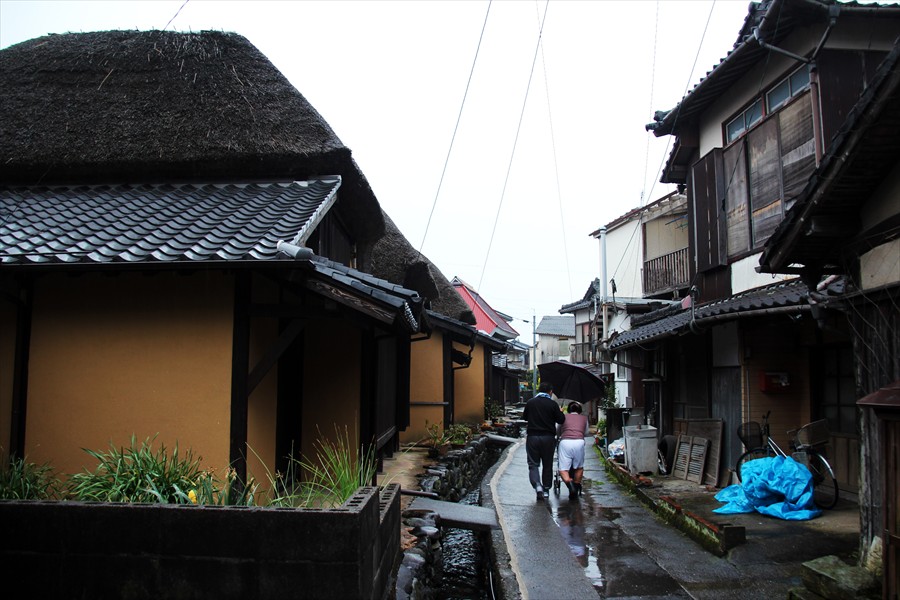
The photograph before one is Shukuba, but the scenery of the former fishing village is left in the edge of a town. The old house having a traditional roof of thatch is slightly seen.

Character

Name: Nabeshima, Tokubetsu-junmai, Kassei-Nigori, Namasake (鍋島、特別純米、活性にごり、生酒)
Place: Fukuchiyo-Brewery (富久千代酒造), Kashima, Saga prefecture
Class: Tokubetsu-Junmai
Rice: Yamadanishiki (山田錦) and  Saganohana (佐賀の華)
Rice polishing rate: 55%
Yeast: Unknown
Filtration: No
Heat treatment: No
Water addition: Yes
Other characteristics: Kassei, Nigori
Alcohol content: 15-16%
Sake meter: +5
Acid meter: 1.6
Price: JPY 2,862 (1,800ml)
Official website: http://nabeshima.biz/
My rating: B (BB "After the time has passed")

The manual is concise.

Taste

There are few fragrances, but is sweets reminding of fruit. It is a refined fragrance.

And I took a sip. Naturally a bubbly wild carbonic acid stimulated my tongue first because it is Kasseishu. The sweetness is felt slightly by the depths, but I receive an impression giving in to other taste. It is taste such as the desert if I say because the impact of the carbonic acid is considerably strong with the Sake of the impression that is dry taste.

In the case of Nigori, the added flavor in the course of the brewing of rice is one of the charm, but is not the thing which is comfortable just to be gritty about this Sake.

Rather the which I drank after I put time, and some carbonic acid fall out becomes slightly delicious. However, still the rough touch of rice continues staying on a tongue and changes into bitterness finally. There is predominantly in comparison with usual Nabeshima little Umami.

There was a much favorite Sake in Kasseishu, but this Sake was not slightly good enough without swelling of the taste being felt. I made up my mind to drink delicious "Nabeshima, Junmai-ginjo, Namasake" passably when I drank on the next time.

I think that sashimi or sushi and affinity are good because I don't feel it that much, as for the sweetness. The taste is thick, but is the thing which does not disturb a meal.

My story

As previously described, it is one of the liquor which made me a Sake enthusiast. The encounter of me and Nabeshim is time when I drank from the uncle who is a teacher in the whole Liquor rather than the Sake. It was Nabeshima, Junmai-ginjo, Namasake delicious commonly then to have drunk. Thereafter, it had many things more than Ginjo that I bought.

When I drank in a bar, there was much Nabeshima. "What kind of Nabeshima is available today?" I asked a salesclerk it in the opening first. "I had orange labels of Nabeshima today" even if I said nothing soon, the salesclerk told it.

Then would I really drink Nabeshima dozens of times? I like "Nabeshima, New-moon" which is Shinshu in particular. I like what's called which rice was used for Aiyama (愛山) with unique sweetness. I like relatively inexpensive, delicious "Ura-Nabeshima (裏鍋島)".

However, it was long silence because the Sake which, besides, was delicious gained power recently. Therefore my this opportunity is interregnum really since one year ago for that matter.

This is Ura-Nabeshima. Ura means the underside. So you will understand that the letter of the label turns over. This Sake called the extra stand, and is the thing of the position. It is the Sake which is satisfactory drinking very much because various kinds of parts that the taste is especially thick squeezed last are blended. It is hard to obtain this, but is favorite one of me.
It was what I understood later, but I seemed to have drunk this Kassei-Nigori only once in old days. I had the thing pointed out when I told what I bought to my uncle. Probably, "I don't remember well" will be that the impression in particular was not left about the taste either.

The story when I went to Fukuchiyo-Brewery thinks to write it, when I introduce delicious Nabeshima next.

This is Fukuchiyo-Brewery. This is old and is a small building, but a big factory is built in the depths.

How to buy (or drink)

It is the Sake with the popularity like Hiroki, but it is not so difficult to buy a bottle because there is relatively much quantity of production. However, there are few shops to sell unexpectedly. It is Machidaya (Google maps) of Nakano to be famous in that. It is inconvenience slightly far from the station, but you do your best, and endure it.

Naturally there are many places stocked in a bar. A lot of shops stocking will come out if you search it with "鍋島" in the following sites. It is mellow, but it is recommended to drink in a bar because there is much liquor in accord with a dish.
http://tabelog.com/